Saturday, December 7, 2013

Uranium mine spill near Jabiru, Northern Territory, locals fear for Kakadu National Park - ABC News (Australian Broadcasting Corporation)

Uranium mine spill near Jabiru, Northern Territory, locals fear for Kakadu National Park - ABC News (Australian Broadcasting Corporation)

Uranium mine spill near Jabiru, Northern Territory, locals fear for Kakadu National Park

Updated 1 hour 16 minutes ago
There has been a serious spill of contaminated slurry at a uranium mine near Jabiru in the Northern Territory.
The Ranger mine's operator Energy Resources of Australia (ERA) said a tank in the processing area of the mine failed about 1:00am.
Workers discovered a hole in the side of the tank and were evacuated before the tank burst and "a mixture of slurry escaped".
The mine is surrounded by Kakadu National Park and is located about 230 kilometres east of Darwin.
Traditional owner groups said they are "sick with worry" about the potential environment impact, but ERA spokesman Tim Eckersley said there is no environmental emergency.
"They evacuated the area and at about 1:00am the tank basically split at the bottom and the processing slurry, which is a mixture of mud and water, has spilled out the bottom of the tank.
"That's the beginning of our processing operations, so it's a mixture of ground-up uranium ore and acid."
He said the material mostly spilled onto compacted earth, tarmac and drains.
"It's very impervious material so there's very little chance of it leaking into the soil there."
The company said earlier in a statement that the slurry moved outside the containment area, but was captured and contained on-site.
"As the material was contained within the processing area there is no impact on the environment surrounding the Ranger Project Area."

Friday, December 6, 2013

Citizen Space - Laurel Formation Tight Gas Pilot Exploration Program, Shire of Broome and Shire of Derby-West Kimberley

Citizen Space - Laurel Formation Tight Gas Pilot Exploration Program, Shire of Broome and Shire of Derby-West Kimberley


Laurel Formation Tight Gas Pilot Exploration Program, Shire of Broome and Shire of Derby-West Kimberley

Buru Energy Limited proposes to undertake tight gas stimulation using hydraulic fracturing of four existing exploration wells (2 in the Yulleroo region and 2 in the Valhalla-Asgard region) in the Canning Basin area of Western Australia.

Give Us Your Views

Online Survey

Related Documents

Monday, December 2, 2013

Make a submission of objection BURU'S BULLSHIT

FRACKING THE TRUTH


  • The depth of shale deposits in WA means fracking is safe.This claim is false – the depth of gas bearing rocks has little relevance to the two main causes of water contamination from this activity.
  • WA has a lot of experience with shale gas fracking. This claim is highly misleading – only a handful of shale gas wells have been fracked in WA during exploration to date.
  • Opponents of shale gas fracking are confusing it with Coal Seam Gas. This claim is untrue – there is no confusion although similarities do exist.
  • Shale gas is a ‘clean’ source of energy. This claim is based on selective accounting – shale gas is likely to be as polluting as coal.
  • There is a robust regulatory framework for shale gas in WA. This claim is highly questionable – the regulator lacks the powers necessary to protect the environment and communities.
While we have come to expect misleading public-relations spin from the gas industry, the fact that government regulators paid by WA taxpayers are engaged in these activities is astonishing,
Recent comments by Bill Tinapple from the Department of Mines and Petroleum demonstrate the serious conflict of interest that results from a government agency charged with both promoting gas fracking, and regulating the environmental impacts of the industry.
By totally dismissing serious environment and health concerns, these statements only serve to further undermine community confidence in the already inadequate regulatory system that is supposed to protect WA communities and the environment from this highly risky activity.

Thursday, November 28, 2013

Think tank ramps up stance against coal seam gas

Think tank ramps up stance against coal seam gas


"The paper, jointly published with The Social Justice Initiative, describes the case against expansion of the coal seam gas and shale gas industry as overwhelming.
“All the evidence suggests the risks to human health and the climate just aren’t worth it,” said Social Justice Initiative researcher Jeremy Moss.

The paper looks set to fuel further public and political debate on the risks and merits of coal seam gas and shale gas development in Australia. It follows a separate report released by the Australia Institute in October, which criticised the petroleum industry for failing to address public concerns about coal seam gas.

The Australia Institute said that research analysed for the latest paper found serious health impacts associated with chemicals used in gas extraction process of hydraulic fracturing, known as fracking. A separate risk involves the danger from contaminated waste water produced during the fracking process, the report notes, pointing to cases in the US where waste water accidents have affected livestock and soil tests have revealed high levels of materials toxic to humans.

The unconventional gas industry argues that properly regulated fracking and gas extraction in general are safe, and that gas wells are constructed to ensure no gas leaks to neighbouring bores and aquifers."

The Kimberley - Coast Australia

The Kimberley - Coast Australia
Richard Hunter and Tim Flanney at James Price Point 


The Kimberley: 80 Mile Beach to Freshwater Cove
Airs Monday December 2 at 7.30pm
In the pristine Kimberley of Western Australia, Neil Oliver discovers Broome’s dark pearling history and the delicate science of their cultivation. Tim Flannery walks in primeval tracks along the legendary Dinosaur Coast. Xanthe Mallett explores a unique maritime war grave. Brendan Moar learns the art of Indigenous raft making and Emma Johnston investigates the lush, protected habitat of migratory shorebirds. Neil Oliver wrestles the southern hemisphere’s biggest tides at the surging Horizontal Falls, and finally experiences the dreaming stories through a little sacred maintenance on some ancient rock art at Freshwater Cove.

CFMEU report says most Australians have not benefited from the mining boom - ABC News (Australian Broadcasting Corporation)

CFMEU report says most Australians have not benefited from the mining boom - ABC News (Australian Broadcasting Corporation)

A new report says Australians are not seeing enough economic benefits from the country's once-in-a-century mining boom.
3900190-3x2-940x627.jpg 
A study commissioned by the Construction, Forestry, Mining and Energy Union found the share of industry income paid in wages has dropped, while mining company profits have surged over the past 20 years.
It also says record mining industry profits have outstripped growth in taxes and royalties.
CFMEU mining division general secretary, Andrew Vickers, says the economic benefits of the resources boom have been highly concentrated.
"Australia as a country and Australians generally haven't benefited from the mining boom, the unprecedented mining boom we've seen over the last ten years," he said.
"And the alarming thing is just how well companies have done out of it. What tax they haven't paid compared to what they sprout about themselves paying," he said.

Buru Energy lodges Environment Plan for 2014 Tight Gas Program


Media Release
26 November 2013
Buru Energy lodges Environment Plan for 2014 Tight Gas Program
Buru Energy has today lodged its Environment Plan (EP) with Department of Mines and Petroleum (DMP), seeking approval for its proposed pilot exploration program for tight gas in the Canning Basin, in Western Australia’s north-west.
The comprehensive document details Buru Energy’s plans to undertake testing for tight gas flows in the Canning Basin’s Laurel Formation, at depths of about 2,000m-4,000m. The Canning Basin landscape is a vast arid area in the Kimberley, dominated by large grazing properties and desert land.
Subject to approvals, testing in the basin will be carried out using hydraulic fracturing, or fraccing to stimulate the flow of gas from the rock formation. Hydraulic fracturing will be undertaken in four existing wells – two at Yulleroo, about 80km east of Broome, and two at Valhalla/Asgard, about 320km east of Broome.
Buru Energy Managing Director Dr Keiran Wulff said the exploration program for 2014 would help determine the commercial potential of tight gas in the Laurel Formation which may contain the largest onshore natural gas resource in Australia. 

More shale gas flows generate growing international interest | The Australian

More shale gas flows generate growing international interest | The Australian

Buru and Mitsubishi agreed to sell a 50 per cent stake in their Coastal Permits to Apache in return for $25m of exploration next year. There was also a $7m-plus option fee to enter other ground, the Acacia Permits.
- See more at: http://www.theaustralian.com.au/business/mining-energy/more-shale-gas-flows-generate-growing-international-interest/story-e6frg9df-1226753080632#sthash.R8Osa2yY.dpuf

Friday, November 22, 2013

Vic fracking ban continues - Weekly Times Now

Vic fracking ban continues - Weekly Times Now

Energy and Resources Minister Nicholas Kotsiras will then conduct a 12-month community consultation program with relevant stakeholders ahead of a final report to be released in July 2015.

Dr Napthine said it was imperative that onshore gas mining have no impact on underground water supplies and aquifers.

"We will never, ever allow onshore gas if it jeopardises our underground water, if it jeopardises our environment and if it jeopardises food and agriculture production,'' he told reporters in Melbourne this morning.

Dr Napthine said the moratorium on fracking "will be continued for the foreseeable future and until at least June 2015 when the community consultation will be completed''.

Legislation will also be introduced to ban the use of the controversial BTEX chemicals in Victoria.

Thursday, November 21, 2013

Buru's Bullshit


Buru are planning to undertake over 32 fractures in four existing wells on the Roebuck Plains in 2014. They are misleading the public by claiming that fracking is a  proven and safe process. They state that they will ensure the best and the most scientific practises to protect the Kimberley water source.

Their care can be clearly seen (not) in this video of their current practises and work sites. Buru claim that they will use only 31 megalitres of water in these planned fracking activities in 2014 and that Fracking fluid will be just 0.2 of that water use.

They go on to state in our local newspaper that fracking fluids are safe and are common in household products but are just in tinier qualities. Buru state they are western Australian and that they care for the Kimberley!.


On the 17th of Dec, Buru are planning a community information session in Broome at the Civic Centre from 2pm - 5.30pm. However, you are encouraged  to register your interest to attend.
Buru's Bullshit

Tuesday, November 19, 2013

Greenhouse gas emissions hit highest level ever

Greenhouse gas emissions hit highest level ever

Major resource agencies invasion of the Dampier Peninsula

Law Boss Joseph Roe and Premier Colin Barnett at odds over Walmadany | The Stringer

Law Boss Joseph Roe and Premier Colin Barnett at odds over Walmadany | The Stringer
Phillip Roe

Mr Roe said the Kimberley should be kept free from industry and its effects and that no processing of LNG onshore was appropriate.

“Premier Barnett thinks he is now the owner of our sacred sites and of our burial sites. But how he secured this acquisition is a matter for inquiry. Everyone knows he bullied and dictated and it is not just conspiracy talk, it was there for the whole of the nation to see.”
“There should be a Royal Commission. I have said all along that there should have been one, and I still say there should be a Royal Commission into Premier Barnett’s acquisition of our land, our heritage. The Australian people should not sit idly by and watch more of us steamrolled.”
“Furthermore, the acquisition does not mean he is allowed to build any industries. He needs to go through process and negotiations but that’s who he is, pushing what he wants while disregarding all of us as he did with threatening our peoples to sign or that he would take the land.”
“Is this the sort of Premier the Australian people want? Is this the sort of Government the Australian people want? Is this the sort of Australia people are proud of? Is this how non-Indigenous Australians want to see us treated?”
“We stood in his way with Walmadan Tent Embassy and torpedoed the gas hub, and we will stand again in the way.”

Frack off, say clans on exploration bid | News | NT News | Darwin, Northern Territory, Australia | ntnews.com.au

Frack off, say clans on exploration bid | News | NT News | Darwin, Northern Territory, Australia | ntnews.com.au

Eddie Mason has come to Darwin to tell the Territory Government he doesn't want oil and gas exploration off the Arnhem Land coast. Picture: JUSTIN SANSON
EDDIE Mason has come to town to tell the Territory Government he doesn't want oil and gas exploration off the Arnhem Land coast - and he doesn't want 99-year leases on his land.
The Maningrida resident and Bulachani clan law man said he had been given permission to speak on behalf of the 25 clans of the Amburra Nation and Japana Nation.
And he said the Government would not come and see him. He has hand-delivered a letter to a representative of Chief Minister Adam Giles at the Northern Territory Legislative Assembly.
Mines and Energy Minister Willem Westra van Holthe said he had met with Mr Mason earlier in the year and said he would meet him and other traditional owners in Maningrida.
"I was disappointed that Mr Mason didn't make prior arrangements for a meeting ... while we were both in Darwin," he said.

Saturday, November 16, 2013

Sonali Kolhatkar: Haiyan: A Disaster Made Worse by Greed -Sonali Kolhatkar -Truthdig

Sonali Kolhatkar: Haiyan: A Disaster Made Worse by Greed -
Sonali Kolhatkar -
Truthdig


 the fact that we are already in an age of superstorms like Haiyan, many individuals and organizations are in fact doing their best to curb greenhouse gas emissions. In Canada, First Nations people are taking action to halt fracking operations. Students in the U.S. are calling on their universities to divest from the fossil fuel industry. International activists working with Greenpeace are currentlybeing held in Russian prisons for challenging Arctic oil drilling. Even a former senior executive from the oil and gas industry has joined the fight against global warming

Indeed, if we are to survive as a species, urgent action is imperative. Hilo told me, “People have no other option but to organize themselves and fight back. From the fight against tar sands in North America, to the fight against large-scale mining in the Philippines, people are asserting their rights to exist.” She added on a personal note, “I have to channel my grief into action.”

Friday, November 15, 2013

Coalition changes environment protection laws - ABC Rural (Australian Broadcasting Corporation)

Coalition changes environment protection laws - ABC Rural (Australian Broadcasting Corporation)


"It will mean green groups can't take action against approved projects on those grounds in future, because the grounds were largely technical and don't go to the matter of environmental protection which is what the Act is all about."
The proposed Venture Minerals' Riley Creek mine is currently before the courts.
Situated within the Tarkine region, the proposal triggered the EPBC Act and was given Commonwealth Approval this year.
Save the Tarkine has challenged this project in the Federal Supreme Court, on the basis that the minister failed to consider the bio-conservation advice.
Head of the organisation Scott Jordan says the timing of the introduction of this amendment could have implications for that case.
"It's odd that the current minister is putting forward that amendment when next month we're actually having this case heard," he said.
"It begs the question, is the intent to avoid another embarrassing court decision?"

Thursday, November 14, 2013

Buru’s oil boom back on track


Buru’s oil boom back on track
Thursday, 14 November 2013
David Upton

Yulleroo tailings dam from fracking photo taken 8th Nov2013
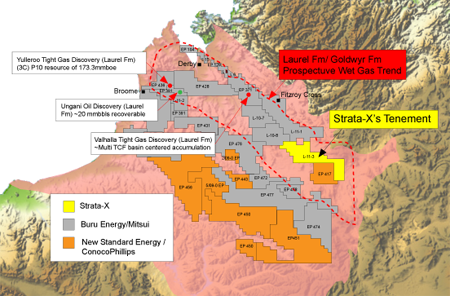
AFTER an agonising delay of 12 months, Buru Energy is finally set to answer one of the biggest questions on the Australian oil patch: how big is Ungani?
The question has been hanging since Ungani-1 intersected a 50 metre oil column in a previously unrecognised carbonate reef play two years ago. 

Buru moved quickly to drill Ungani-2 and Ungani North-1, as well as going into the field with 3D seismic survey of the surrounding area of 240 square kilometres.

However, the survey was voluntarily suspended in October last year after traditional landowners reported the seismic crew had disturbed an Aboriginal heritage site.

A lengthy investigation by WA’s Department of Aboriginal Affairs cleared Buru and its contractors last month of wrong-doing, finding no evidence of any disturbance to an Aboriginal heritage site.

While no harm was done to Aboriginal heritage, there had been plenty of damage on the sharemarket, with Buru’s share price halving over the 12-month delay period to about $1.50.

Buru reached agreement with traditional owners in July on all aspects of exploration and development at Ungani, allowing a restart of clearing for the 3D survey.

Shooting the survey began in early September and was completed just three weeks ago.
In a statement earlier this week Buru managing director Keiran Wulff was able to provide shareholders with some encouraging early results.


He stated the preliminary data suggested Ungani was at least as big as Buru’s median case of 10 million barrels of recoverable oil, and could have significant upside.

“Interestingly, [the 3D survey] also shows some other prospects in that immediate vicinity that look like very attractive Grant closures above and just to the side of the field,” Wulff said.

“The final processing of the seismic data is still not quite completed, but we are pleased by the quality of the data and most importantly the clarity of the structural definition.

“The data received so far has enabled us to delineate our next drilling locations and we will be preparing the well sites ahead of the rig arriving in mid to late December.”

All of the data from the 3D survey is due to be processed by the end of next month, which will be a big step towards answering the question about the size of the Ungani field.

It is hoped the Ungani-3 appraisal well, which is due to spud next month, will provide confirmation of the interpreted size of Ungani, although it is possible a further well will be needed to provide enough certainty.

The high case for Ungani in previous assessments has been 20 million barrels of recoverable oil.

If the actual size approaches this figure, Buru can expect a whole new wave of excitement about the discovery.

Then, if there are multiple Ungani look-alikes in the vicinity of the original discovery, Buru could even find itself be at the centre of a new boom in Australia’s onshore oil production.

Unfortunately for other explorers Buru and its partner Mitsubishi have a tight grip on all the acreage over the Ungani oil trend, which extends over an area of 40 kilometres by 120 kilometres.

A recent research update from Deutsche Bank, which underwrote Buru’s $35 million placement with institutional investors in August, stated that “we understand the next two-plus exploration wells will target prospects with recoverable oil potential of over 30 million barrels each”.

The potential of Ungani is also hinted at in recent production forecasts by the company.
Phase 1 of the Ungani development is expected to produce between 1000 and 2000 barrels per day gross.

Buru and Mitsubishi are equal partners in the field.

Phase 1 is an extended production test that is due to restart later this month following a workover of Ungani-2, the upgrade of production facilities and the construction of an oil export facility at the Port of Wyndham.

Phase 2 is the full field development, including horizontal wells, and is planned to boost production to 5000 barrels per day by the end of next year.

With Phase 3 will come the development of new discoveries as part of an Ungani cluster. Buru believes there is potential in this phase for gross production to 15,000 barrels per day from the end of the following year.

In phase 3, Buru’s net production would total more than 2.5 million barrels per annum. This would make the company one of Australia’s top 10 oil producers, based on current rankings.

With so much at stake, the news from Buru will be closely watched over the next few months.